

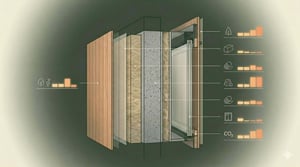
What is an EPD?
An Environmental Product Declaration (EPD) is a standardized, third-party verified document that quantifies the environmental impact of a product across its life cycle. It is based on Life Cycle Assessment (LCA) data and follows two international standards: ISO 14025 (the declaration format) and EN 15804 (the rules for construction products specifically).
In practice, an EPD lets you compare the climate impact of building materials using verified numbers instead of marketing claims. Program operators like EPD-Norge, The International EPD System (Environdec), and RTS in Finland publish and maintain searchable databases of these declarations. If you have worked with BREEAM, LEED, or DGNB certifications, you have probably already encountered EPDs as a requirement for earning material credits.
Why should you care?
Here is the problem most architects run into: you want to make lower-carbon material choices, but you have no reliable way to compare options. One insulation manufacturer says their product is "sustainable." Another says the same. Both have nice brochures. Neither gives you data you can actually use in your LCA calculations.
EPDs solve this by forcing manufacturers to show their work. The data comes from a full Life Cycle Assessment, verified by an independent third party, and presented in a standardized format. That means you can compare two competing products on equal terms, same methodology, same indicators, same rules. No more guessing.
The timing matters too. Regulations across Norway, Sweden, and Finland are tightening fast, and all of them depend on EPD data:
-
Norway: Updated TEK requirements and DFO’s public procurement rules now push toward documented carbon budgets. DFO’s criteria for public buildings explicitly reference EPD-based environmental data (source: anskaffelser.no).
-
Sweden: The klimatdeklaration law (Lag om klimatdeklaration for byggnader, SFS 2021:787) requires carbon reporting for new buildings. Boverket’s guidance points to EPDs as the primary data source (source: boverket.se).
-
Finland: The building act includes carbon footprint requirements that reference EPD-documented material data (source: ym.fi).
Without EPDs, you are working with generic data that might not reflect the actual products going into your building. With them, you know.
What does an EPD actually contain?
A typical EPD for a building product has four main parts. Knowing what to look for makes them much less intimidating to read.
1. Product information
Manufacturer, product name, declared unit (for instance, 1 m² of facade cladding or 1 ton of concrete), and intended use. The declared unit is important because it defines what all the numbers below refer to.
2. Life cycle stages covered
EPDs report impacts across standardized modules:
-
A1–A3 (Product stage): Raw material extraction, transport to factory, manufacturing. This is the minimum any EPD must cover.
-
A4–A5 (Construction): Transport to site and installation.
-
B1–B7 (Use): Maintenance, repair, replacement, operational energy and water.
-
C1–C4 (End of life): Demolition, transport, waste processing, disposal.
-
D (Beyond the life cycle): Potential benefits from reuse, recovery, or recycling.
A "cradle-to-gate" EPD covers only A1–A3. A "cradle-to-grave" EPD goes through C4. More stages mean a more complete picture, but when comparing products you need to make sure you are looking at the same scope.
3. Environmental impact indicators
This is the core. The most relevant ones for building design:
-
GWP (Global Warming Potential): Measured in kg CO₂ equivalents. This is the number you will use most. It tells you the carbon intensity of producing that material.
-
ODP (Ozone Depletion Potential)
-
AP (Acidification Potential)
-
EP (Eutrophication Potential)
-
POCP (Photochemical Ozone Creation Potential)
-
ADP (Abiotic Depletion Potential), both for non-fossil resources and fossil resources.
For day-to-day design decisions, GWP in modules A1–A3 is usually where you start. The other indicators matter for deeper analysis, but GWP is the one driving regulatory requirements right now.
4. Resource use and waste
Renewable and non-renewable primary energy use, secondary materials, and waste flows. Less commonly used in early design, but relevant for full LCA documentation.
What is the difference between an EPD and an LCA?
People mix these up constantly, so let’s be clear: an LCA is the analysis. An EPD is the standardized way of communicating the results.
A Life Cycle Assessment (governed by ISO 14040/14044) is a method for quantifying environmental impacts. It involves collecting data on energy use, material inputs, emissions, and waste at every stage of a product’s life. An EPD (governed by ISO 14025 and EN 15804) takes those LCA results and presents them in a format that allows apples-to-apples comparison.
Think of it this way: an LCA is like the audit, the EPD is like the financial statement that comes out of it. You need the audit to produce the statement, and you need the standardized statement format to compare companies.
| LCA | EPD | |
| What it is | An analytical method | A standardized document |
| Governed by | ISO 14040 / ISO 14044 | ISO 14025 / EN 15804 |
| Purpose | Quantify environmental impacts | Communicate LCA results in a comparable format |
| Verified by | Peer review (optional) | Independent third-party verification (required) |
| Scope | Any product, service, or system | Typically a specific product or product group |
If you already work with LCA in building design, you will recognize the modular structure (A1–D) in EPDs. Same framework, just applied at the product level instead of the building level.
Where to find EPDs
The main databases for Nordic markets:
EPD-Norge (epd-norge.no). The Norwegian program operator, part of the ECO Platform network. If you are working on Norwegian projects, start here.
Environdec / The International EPD System (environdec.com). Based in Sweden, but global in scope. Many international manufacturers register here.
RTS EPD (rts.fi). Finland’s program, operated by Building Information Foundation RTS.
ECO Platform (eco-platform.org). The European umbrella that connects national programs and enables mutual recognition across borders. Useful when you need to search across multiple countries.
OKOBAUDAT (oekobaudat.de). Germany’s public database, often used as a reference in European LCA tools.
When a product-specific EPD does not exist for something you are specifying, LCA tools typically fall back on generic data from Ecoinvent or OKOBAUDAT. Generic data works as a baseline, but it might significantly over- or underestimate the actual impact of a specific product. Product-specific EPDs are always more accurate.
How to read an EPD (without getting lost)
EPDs can look dense. Here is where to focus.
Check the declared unit first. If one EPD reports per square meter and another per kilogram, you cannot compare directly without converting. This trips people up more than it should.
Match the scope. An EPD covering A1–A3 is not comparable to one covering A1–C4 without adjustments. Always check which modules are included before drawing conclusions. Select and focus on the same modules you want to compare it to.
Find the GWP number. For most design decisions, the Global Warming Potential in modules A1–A3 is your starting point. It gives you the carbon footprint of producing that material, per declared unit.
Check the date. EPDs are valid for five years. An expired one might still be directionally useful but always look for a current version first.
Product-specific vs. industry average. Is the EPD based on data from a specific factory, or is it a sector average? A product-specific EPD from the actual manufacturer you are specifying will always be more accurate. This distinction can make a real difference, sometimes the specific product performs 30–40% better than the generic average for its category.
Using EPD data in BIM
This is where it gets interesting for anyone working in Archicad or similar BIM tools. Looking up EPDs manually for every material in a project is tedious and error-prone. The better approach is to connect EPD data directly to your building model.
When environmental data is linked to BIM elements, you see the carbon impact of your design choices in real time. Change a material, swap a structural system, adjust a facade, and the numbers update automatically. That feedback loop changes how you think about material selection. Instead of doing an LCA check at the end of the project (when it is too late to change much), you are making informed choices throughout the design process.
Tools like Anavitor are built for this workflow. EPD-based environmental data connects to your model, and you get continuous feedback as you design. The result is that EPDs stop being compliance paperwork you deal with at the end and become a design input you use from the start.
That shift, from afterthought to design tool, is where the real impact on building sustainability happens.
Frequently asked questions
What is an EPD in simple terms?
An Environmental Product Declaration is a verified document that reports the environmental impact of a product based on Life Cycle Assessment data. It follows ISO 14025 and EN 15804 and must be verified by an independent third party before publication.
Are EPDs mandatory?
Not universally, but in practice they are becoming hard to avoid. Norway’s DFO procurement rules, Sweden’s klimatdeklaration law (SFS 2021:787), and Finland’s building act all require environmental data that effectively depends on EPDs. Certification systems like BREEAM, LEED, and DGNB also require or reward EPD-documented materials.
How long is an EPD valid?
Five years from publication. After that, the manufacturer needs to renew with updated LCA data.
What is the difference between a product-specific and an industry-average EPD?
A product-specific EPD is based on data from one manufacturer’s actual production. An industry-average EPD aggregates data across multiple manufacturers. Product-specific is always more accurate for comparing individual products. Industry-average serves as a fallback when specific data is not available.
Where can I find EPDs for building products?
For Nordic markets: EPD-Norge (epd-norge.no) for Norway, Environdec (environdec.com) for Sweden and international products, RTS EPD (rts.fi) for Finland. ECO Platform (eco-platform.org) searches across multiple national programs.
Can EPD data be used directly in BIM?
Yes. LCA tools that integrate with BIM software connect EPD data to building elements in your model. This lets you assess environmental impact during design instead of after the fact.
